
Papahānaumokuākea


Country
United States of America (USA)
Inscribed in
2010
Criteria
(iii)
(vi)
(viii)
(ix)
(x)
The conservation outlook for this site has been assessed as "good with some concerns" in the latest assessment cycle. Explore the Conservation Outlook Assessment for the site below. You have the option to access the summary, or the detailed assessment.
Papahānaumokuākea is a vast and isolated linear cluster of small, low lying islands and atolls, with their surrounding ocean, roughly 250 km to the northwest of the main Hawaiian Archipelago and extending over some 1931 km. The area has deep cosmological and traditional significance for living Native Hawaiian culture, as an ancestral environment, as an embodiment of the Hawaiian concept of kinship between people and the natural world, and as the place where it is believed that life originates and to where the spirits return after death. On two of the islands, Nihoa and Makumanamana, there are archaeological remains relating to pre-European settlement and use. Much of the monument is made up of pelagic and deepwater habitats, with notable features such as seamounts and submerged banks, extensive coral reefs and lagoons. It is one of the largest marine protected areas (MPAs) in the world. © UNESCO
Summary
2025 Conservation Outlook
Finalised on
11 Oct 2025
Good with some concerns
Current state and trend of VALUES
Low Concern
Overall THREATS
Overall PROTECTION and MANAGEMENT
Full assessment
Description of values
Illustrating example of island hotspot progression
Criterion
(viii)
The property provides an illustrating example of island hotspot progression, formed as a result of a relatively stationary hotspot and stable tectonic plate movement. Comprising a major portion of the world’s longest and oldest volcanic chain, the scale, distinctness and linearity of the manifestation of these geological processes in Papahānaumokuākea are unrivalled and have shaped our understanding of plate tectonics and hotspots (World Heritage Committee, 2010).
Multitude of habitats and species assemblages
Criterion
(ix)
The large area of the property encompasses a multitude of habitats, ranging from 4,600 m below sea level to 275 m above sea level, including abyssal areas, seamounts and submerged banks, coral reefs, shallow lagoons, littoral shores, dunes, dry grasslands and shrublands and a hypersaline lake. The size of the archipelago, its biogeographic isolation as well as the distance between islands and atolls has led to distinct and varied habitat types and species assemblages (World Heritage Committee, 2010).
Remarkable example of ongoing evolutionary and bio-geographical processes
Criterion
(ix)
The size of the archipelago, its biogeographic isolation as well as the distance between islands and atolls has led to distinct and varied habitat types and species assemblages. Papahānaumokuākea constitutes a remarkable example of ongoing evolutionary and bio-geographical processes, as illustrated by its exceptional ecosystems, speciation from single ancestral species, species assemblages and very high degree of marine and terrestrial endemism. For example, a quarter of the nearly 7,000 presently known marine species in the area are endemic. Over a fifth of the fish species are unique to the archipelago while coral species endemism is over 40% (World Heritage Committee, 2010).
Unique reef ecosystems
Criterion
(ix)
Because of its isolation, scale and high degree of protection the property provides an unrivalled example of reef ecosystems which are still dominated by top predators such as sharks, a feature lost from most other island environments due to human activity (World Heritage Committee, 2010).
Endangered and vulnerable species
Criterion
(x)
The terrestrial and marine habitats of Papahānaumokuākea are crucial for the survival of many endangered or vulnerable species the distributions of which are highly or entirely restricted to the area, such as the threatened green turtle (Chelonia mydas) and the endangered Hawaiian monk seal (Neomonachus schauinslandi), as well as the 14 million seabirds representing 22 species that breed and nest there. Land areas also provide a home for four species of bird found nowhere else in the world, including the world's most endangered duck, the Laysan duck (Anas laysanensis, CR), Laysan finch (Telespiza cantans, VU), Nihoa finch (Telespiza ultima, CR), and Nihoa millerbird (Acrocephalus familiaris, CR) (NOAA, n.d.). The Statement of Outstanding Universal Value also includes six species of endangered plants such as the Fan Palm (Pritchardia remota) (World Heritage Committee, 2010).
Largest tropical seabird rookery in the world
Criterion
(x)
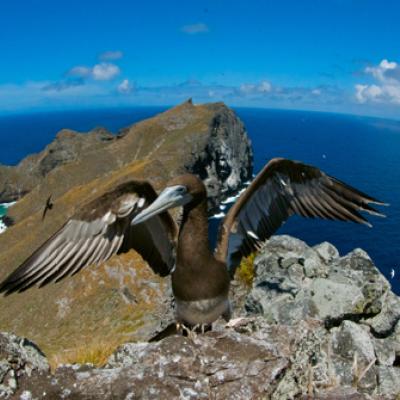
With 5.5 million sea birds nesting in the monument every year and 14 million residing in it seasonally it is collectively the largest tropical seabird rookery in the world, and includes 99% of the world’s Laysan Albatross (Phoebastria immutabilis,
NT) and 98% of the world’s Black-footed Albatross (Phoebastria nigripes,
NT) (World Heritage Committee, 2010).
NT) and 98% of the world’s Black-footed Albatross (Phoebastria nigripes,
NT) (World Heritage Committee, 2010).
Cultural and spiritual value
Papahānaumokuākea is considered a sacred area, from which Native Hawaiians believe all life springs, and to which spirits return to after death (PMNM, n.d.). There are many wahi pana (places of great cultural significance and practice), which, like a lei, are strung together throughout the expanse of the ten main atolls and islands. Papahānaumokuākea is also a place for Native Hawaiian cultural practitioners of today to reconnect with their ancestors and gods, who they believe are manifested in nature, as with the Polynesian deity Kanaloa, who they believe are manifested in nature, as with the Polynesian deity Kanaloa, who they believe is embodied by the vast expansive ocean, and can take the form of all life within it. Many ongoing traditional ceremonies and practices rely on the natural landscape and resources of the site (Hoku et al., 2022).
Assessment information
Most of the current threats were rated as high threat, which largely impact the OUV of the property through pollution (marine debris, lead paint, vessel grounding, landfill) and climate change/weather (tsunami, sea level rise, rising ocean temperature). Eradication of invasive alien species requires long term monitoring and management. The spread and distribution of the cryptogenic red macroalga (Chondria tumulosa) is currently being researched and monitored. Strict protocols are in place to manage for and anticipate introductions from invasive alien species. While the potential for groundings of vessels operating in the site does exist, vessel strikes from vessels passing outside the boundaries of the site are limited by the International Maritime Organization’s designation of the site as a Particularly Sensitive Sea Area. Overarching climate change impacts are also being planned for but are difficult to manage given the global influences that are driving this change.
Water-borne & other effluent Pollution, Garbage & Solid Waste
(Marine debris)
Inside site
, Widespread(15-50%)
Outside site
The major form of marine pollution both inside and outside of Papahānaumokuākea Marine National Monument boundaries continues to be marine debris (State Party of the United States, 2024). Although no commercial or recreational fishing is permitted in Papahānaumokuākea waters, derelict fishing nets and gear, plastics and other ocean-borne debris are concentrated by ocean currents and wash up on the reefs and beaches of the islands. Entanglement in marine debris has been identified as a major threat to the endangered Hawaiian monk seal. Debris entanglement also threatens sea turtles, seabirds, cetaceans and coral reef organisms. In addition, ingestion of plastics causes significant mortality in many seabird species. Estimates of marine debris impacts are almost 60,000 pounds accumulation per year (State Party of the United Sates, 2024). Since 1996, a large-scale effort to remove marine debris from the monument has resulted in 1,167 metric tons (more than 2 million pounds) of primarily derelict fishing gear and plastics removed. To combat the debris and mitigate its hazards, multiple partners collaborate on this removal mission every few years to clean debris from the World Heritage Site and its shores. The NOAA Marine Debris Program has been involved in this effort since the Program was established in 2006, and is now supporting efforts led by the National Fish and Wildlife Foundation and Papahānaumokuākea Marine Debris Project through funding provided by the Bipartisan Infrastructure Law (NOAA Marine Debris Program 2024).
Pathogens
(Coral disease)
Inside site
, Localised(<5%)
Outside site
The incidence of diseases affecting marine organisms is increasing globally, but the factors contributing to disease outbreaks remain poorly understood. The overall average prevalence of coral disease is quite low in the Northwestern Hawaiian Islands as compared to other coral reef areas (Aeby, 2006). Recent studies have begun to document these disease baselines in corals and other associated marine animals such as fish and sea turtles. In 2011, one site previously surveyed and monitored at French Frigate Shoals (FFS) had seen a significant reduction in the density of Acropora cytherea due to colonies dying from one of the growth anomalies and ‘white syndrome’ associated with the diseases found in the Northwestern Hawaiian Islands. Most other monitored sites have not seen significant reductions in densities of corals (Steven, 2012). No updated information has been identified on this subject.
Shipping Lanes
(Vessel groundings)
Inside site
, Widespread(15-50%)
Outside site
Hazards to shipping and other forms of maritime traffic such as shallow submerged reefs and shoals are inherent in the Northwestern Hawaiian Islands. The region is exposed to open-ocean weather and sea conditions year-round, punctuated by severe storm and wave events in winter. Hence vessel groundings and the release of fuel, cargo, and other items pose real threats to the Northwestern Hawaiian Islands (Selkoe et al., 2008). Additionally, vessel traffic could also facilitate the introduction of invasive alien species. These threats are greatly reduced by the national and international maritime management measures in effect for this site. In April 2008, a designation by the International Maritime Organization (IMO), declared the waters of Papahānaumokuākea a “Particularly Sensitive Sea Area” (PSSA), implemented a mandatory ship reporting system and expanded and consolidated existing Areas To Be Avoided (ATBA) into four larger ATBAs (Papahānaumokuākea, 2012). While there is minimal vessel traffic to the islands, there has been a major increase in the use of the designated corridors for large commercial vessel passage between Lisianski and Pearl and Hermes (State Party of the United States, 2024).
Other Human Disturbances
(Research and conservation activities both on land and nearshore)
Inside site
, Localised(<5%)
Permits may be issued in one of six permit categories: research, education, conservation and management, Native Hawaiian practices, special ocean use, and recreation. The Monument Co-Trustees grant both single- and multi-year permits. Of the permitted activities, research and conservation and management received the most permits (Papahānaumokuākea Marine National Monument, 2019). Human presence is necessary to carry out resource management objectives and conduct necessary scientific and cultural research. Effectively tracking monument permits and the associated number of permitted vessel and permit related aircraft entries within the monument allows for accurate reporting of levels of human presence. The only location equipped to accept aircraft within the monument is Midway Atoll.
Residential Areas
(Lead paint on old buildings at Midway Atoll and asbestos at French Frigate Shoals)
Inside site
, Localised(<5%)
Some of the buildings on Midway date to 1903, with most of them dating to the period between 1939 and 1993, when the atoll was used as a U.S. Navy base. Studies conducted by the U.S. Fish and Wildlife Service and others between the late 1980s and 2009 showed that Laysan albatross chicks exhibited symptoms of lead toxicity, which causes their wings to droop and prevents them from developing the ability to fly and forage for food, leading to death. The studies found their exposure is likely related to ingestions of lead-based paint chips and soil contaminated with the chips, which the birds often pick up and place into their nests. One study estimated that eliminating the chick mortality from lead poisoning would increase the Laysan population at Midway in 50 years by as many as 360,000 birds over the projected population size without lead-based paint removal (U.S. Fish and Wildlife Service, 2011).
Invasive Non-Native/ Alien Species
(Invasive alien plant, insect and marine species)
Other invasive species names
Chondria tumulosa, Mus musculus, Oryctolagus cuniculus
Inside site
, Widespread(15-50%)
In the past, several of the islands and atolls of Papahānaumokuākea have been heavily inundated by terrestrial invasive alien species. Both Midway Atoll and Laysan Island have incurred multiple introductions, some of which transformed the landscapes. Some of the most invasive introductions were intentional during the days of guano mining, such as vegetation, rats, and rabbits that caused extensive damage. To date, rats and rabbits have been successfully exterminated in Papahānaumokuākea, but various other invasive alien species still affect the inhabited islands and atolls. The Midway Seabird Protection Project recently failed to eradicate house mice (Mus musculus) that attack albatrosses on Sand Island, the larger of the two islands that make up USA’s Midway Atoll in the North Pacific (Cooper, 2023). The number of invasive alien land plants in Papahānaumokuākea varies from only three introduced at Nihoa, to 249 introduced at Midway Atoll. Numerous efforts have been made to eradicate and restore the emergent lands to their native conditions, particularly at Laysan Island and Midway Atoll. Other management and restoration efforts are undertaken annually during the late spring through mid-fall field season. To prevent further importation of invasive plants, animals, and insects, mandatory quarantine protocols are enforced for any visitors to all the islands of Papahānaumokuākea, with the exception of Midway Atoll (Papahānaumokuākea Marine National Monument, 2009). On Sand Island invasive mouse predation has occurred among nesting Laysan albatross (U..S. Fish & Wildlife Service, 2018).
In 2006 a total of nine established marine non-indigenous species were known in the Monument (Godwin et al., 2006). As of March 2020, findings from the marine alien species inventory project have documented that there are potentially 61 non-indigenous species in the Monument. These non-indigenous species consist of two cryptogenic species of red algae, three species of fish and 56 species of marine invertebrates (Tsuda, et al., 2015, Godwin, et al., 2020). Invasive alien species may be introduced accidentally, such as with vessel discharge, marine debris, or aquaculture, or intentionally, as in the case of a few species of snappers, grouper, and algal species (PIFSC-CRED unpublished data.). To date, none of these species has caused significant problems in Papahānaumokuākea Marine National Monument. However, there are a variety of marine invasive species, particularly five species of algae in the main Hawaiian Islands, which if transported to the Papahānaumokuākea, could cause significant changes in species composition. A cryptogenic, invasive-like red macroalga, Chondria tumulosa, was first observed in 2016, and resighted in 2019, forming thick mats on the forereef of Manawai Atoll (also known as Pearl and Hermes Atoll) (Lopes et al., 2023). Subsequent expeditions revealed an increased abundance of this alga. The red alga was observed to form large, thick algal mats that were smothering corals and coral reefs with few other reef species surviving below the mats. Since then it has been identified in isolated areas at Kuaihelani (also known as Midway Atoll) and at Kure Atoll as well (Fumo et al. 2024, Hawaii Department of Natural Resources 2023, Papahānaumokuākea WHS report 2023). The pervasiveness of this alga remains a significant threat to biosecurity in Monument waters (National Marine Sanctuaries, 2019).
In 2006 a total of nine established marine non-indigenous species were known in the Monument (Godwin et al., 2006). As of March 2020, findings from the marine alien species inventory project have documented that there are potentially 61 non-indigenous species in the Monument. These non-indigenous species consist of two cryptogenic species of red algae, three species of fish and 56 species of marine invertebrates (Tsuda, et al., 2015, Godwin, et al., 2020). Invasive alien species may be introduced accidentally, such as with vessel discharge, marine debris, or aquaculture, or intentionally, as in the case of a few species of snappers, grouper, and algal species (PIFSC-CRED unpublished data.). To date, none of these species has caused significant problems in Papahānaumokuākea Marine National Monument. However, there are a variety of marine invasive species, particularly five species of algae in the main Hawaiian Islands, which if transported to the Papahānaumokuākea, could cause significant changes in species composition. A cryptogenic, invasive-like red macroalga, Chondria tumulosa, was first observed in 2016, and resighted in 2019, forming thick mats on the forereef of Manawai Atoll (also known as Pearl and Hermes Atoll) (Lopes et al., 2023). Subsequent expeditions revealed an increased abundance of this alga. The red alga was observed to form large, thick algal mats that were smothering corals and coral reefs with few other reef species surviving below the mats. Since then it has been identified in isolated areas at Kuaihelani (also known as Midway Atoll) and at Kure Atoll as well (Fumo et al. 2024, Hawaii Department of Natural Resources 2023, Papahānaumokuākea WHS report 2023). The pervasiveness of this alga remains a significant threat to biosecurity in Monument waters (National Marine Sanctuaries, 2019).
Changes in Physical & Chemical Regimes, Changes in Temperature Regimes, Changes in Precipitation & Hydrological Regime
(Climate change)
Inside site
, Throughout(>50%)
Outside site
Projected sea level rise, combined with likely increases in storm and wave energy, indicate that there is a high likelihood of inundating low-lying islands within the property and increasing coastal erosion on all islands over the next 50-100 years [high confidence] (Wagner and Polhemus, 2016). Between 2009-2018 sea level has increased by as much as 10 mm in the southeastern portions of the Monument. Beach and coastal strand habitats are very likely to be lost as a result of sea level rise, storm inundation, and erosion with significant implications for endangered species that rely on these habitats for nesting and breeding, including monk seals, sea turtles, and seabirds (Wagner and Polhemus, 2016). On Oct. 3, 2018, Hurricane Walaka transited through the French Frigate Shoals as a category 4 hurricane with sustained winds of up to 125 mph and East island was 95% eroded, due to storm surge from Hurricane Walaka and nearby Trig island was also lost due to intensified wave activity, both of which serve as important habitat for the Hawaiian green turtle, Hawaiian monk seal and seabirds. Habitat dislocation has interfered with the level of pupping and nesting for months (Papahānaumokuākea Marine National Monument News, 2018). Papahānaumokuākea‘s globally important bird population are at risk from the loss and degradation of habitat, changes in prey availability, and direct impacts from changes in environmental conditions, particularly increasing land surface temperatures (Wagner and Polhemus, 2016).
Problems associated with increased sea surface temperatures have been reported in the Northwestern Hawaiian Islands. Sea surface temperature information obtained from NOAA demonstrated that water temperatures at Midway rose nearly two degrees centigrade over the usual summer maxima in August of 2002. Corresponding with this warm water event, substantial coral bleaching was observed—a process whereby coral colonies lose their colour due to the expulsion of symbiotic microscopic algae (zooxanthellae) from most coral tissues—on reefs at the three northwestern most atolls: Kure, Midway, and Pearl and Hermes. A similar thermal anomaly centered over Lisianski Island in 2014 resulted in significant bleaching in shallow waters and mortality of nearly four square kilometers of coral (NOAA 2024).
Problems associated with increased sea surface temperatures have been reported in the Northwestern Hawaiian Islands. Sea surface temperature information obtained from NOAA demonstrated that water temperatures at Midway rose nearly two degrees centigrade over the usual summer maxima in August of 2002. Corresponding with this warm water event, substantial coral bleaching was observed—a process whereby coral colonies lose their colour due to the expulsion of symbiotic microscopic algae (zooxanthellae) from most coral tissues—on reefs at the three northwestern most atolls: Kure, Midway, and Pearl and Hermes. A similar thermal anomaly centered over Lisianski Island in 2014 resulted in significant bleaching in shallow waters and mortality of nearly four square kilometers of coral (NOAA 2024).
Geological Events
(Tsunami)
Inside site
, Widespread(15-50%)
Outside site
In 29 March 2011, the Japan Tsunami washed over large portions of the islands and atolls of PMNM. On Midway 110,000 Black footed and Laysan Albatross chicks were killed representing 22% of the seabird population. An additional 500-600 Black-foot Albatross chicks were killed at Kure Atoll. Tens of millions of dollars in structural damage were also done to Midway Atoll (Reynolds et al. 2017). The risk of such an event reoccurring is growing with climate changes and poses a high threat due to the significant possible consequence on the site's key attributes.
Water-borne & other effluent Pollution, Garbage & Solid Waste
(Land fill contaminants from former military use at Kure and Midway Atolls and French Frigate Shoals)
Inside site
, Localised(<5%)
Uncharacterized, unlined landfills remain on some of these islands. Kure Atoll and French Frigate Shoals both have point sources of PCBs due to former U.S. Coast Guard LORAN stations. While the Coast Guard has mounted clean-up actions at Kure Atoll, elevated levels of contamination remain in island soils, nearshore sediment, and biota. The Navy also left landfills behind on Midway Atoll. Studies have shown that soil can constitute up to 30% of the material a bird consumes, and hence soil contamination from the above substances is a substantial threat to the bird populations (Hui and Beyer, 1998; Beyer et al., 1994). A 2016 remediation project was done at Kure Atoll to relocate carbon-treated contaminated soil from low elevation areas and is expected to minimize the future hazard of release through storms or erosive activities. Additionally, a 2018 study by the U.S. Environmental Protection Agency detected PCBs, PAHs, lead and other contaminants in soil and porewater at Tern Island at French Frigate Shoals from legacy dump activities. In 2018, Hurricane Walaka removed cement and sediment covering a former dump site and exposed potentially hazardous materials (Papahānaumokuākea Marine National Monument News, 2018). It is important to notice that military activity still occurs within the Monument boundary, even if minimal, and is exempted from required management approvals and permissions (State Party of the United States, 2024).
In addition to the currently known invasive alien species, there is the potential for additional non-native species to be introduced, from the main Hawaiian Islands or elsewhere in the world. Climate change is also expected to further damage the OUV of the property, through ocean acidification. Potential future impacts from anticipated mining in high seas areas are also of some concern. Furthermore, protected areas across the United States are facing challenges from government changes which impact staff numbers and funding for operational and management needs, further enhanced by increasing climate change impacts. This creates uncertainty regarding the medium-term impact on sustainable finance for essential management activities. Recent pressure to lift the fishing restrictions in the Pacific marine national monuments, including within the site, is of concern to the conservation of it's values.
Mining & Quarrying
(Impacts from mining in high-seas areas)
Outside site
While seafloor mining does not occur within the property, management authorities are concerned about potential future impacts from anticipated extensive mining in high seas areas, for example, high seas between Hawaii and the West coast of North America (State Party of the United States, 2024).
Removing/Reducing Human Management
(Changes in staff capacity and funding)
Inside site
, Throughout(>50%)
Outside site
US protected areas are facing challenges from government changes which impact federal staff numbers and funding for operational and management needs, further enhanced by increasing climate change impacts (e.g. Matza, 2025; Rosenblat, 2025). This creates uncertainty regarding the medium-term impact on sustainable finance for essential management activities.
Fishing, Harvesting & Controlling Aquatic Species
(Commercial fishing)
Inside site
, Extent of threat not known
Outside site
There has been a renewed push by the Trump administration and the Western Pacific Regional Fishing Management Council to open the Papahānaumokuākea National Marine Sanctuary to commercial fishing (OHA, 2025)
In May 2025, Kāpaʻa, the Conservation Council for Hawai‘i, and the Center for Biological Diversity, represented by Earthjustice, filed a lawsuit against the Trump administration challenging its actions to open the Pacific Islands Heritage Marine National Monument to commercial fishing. The groups are challenging the April 17 proclamation by President Trump that would allow U.S.- flagged vessels to fish commercially in an area that’s long been preserved to protect marine ecosystems, as well as steps taken by the U.S. National Marine Fisheries Service (NMFS) to implement that illegal proclamation. The Trump administration seeks to strip vital protections that President Obama put in place in 2014, when he expanded the monument’s boundaries to include the waters from 50 to 200 nautical miles around Jarvis Island, Wake Island, and Johnston Atoll, banning commercial fishing in those waters (Fox and Phillips, 2025).
Native Hawaiian-led research and advocacy have repeatedly emphasized that cultural access and ecological protection go hand-in-hand, and that commercial fishing is inconsistent with traditional Native Hawaiian stewardship ethics such as kuleana, mālama, and pono. President Trump’s proclamation threatens the ability of future generations to survive and thrive (OHA, 2025). Furthermore, allowing commercial fishing within and/or around the World Heritage site is of concern to the conservation of it's World Heritage values.
In May 2025, Kāpaʻa, the Conservation Council for Hawai‘i, and the Center for Biological Diversity, represented by Earthjustice, filed a lawsuit against the Trump administration challenging its actions to open the Pacific Islands Heritage Marine National Monument to commercial fishing. The groups are challenging the April 17 proclamation by President Trump that would allow U.S.- flagged vessels to fish commercially in an area that’s long been preserved to protect marine ecosystems, as well as steps taken by the U.S. National Marine Fisheries Service (NMFS) to implement that illegal proclamation. The Trump administration seeks to strip vital protections that President Obama put in place in 2014, when he expanded the monument’s boundaries to include the waters from 50 to 200 nautical miles around Jarvis Island, Wake Island, and Johnston Atoll, banning commercial fishing in those waters (Fox and Phillips, 2025).
Native Hawaiian-led research and advocacy have repeatedly emphasized that cultural access and ecological protection go hand-in-hand, and that commercial fishing is inconsistent with traditional Native Hawaiian stewardship ethics such as kuleana, mālama, and pono. President Trump’s proclamation threatens the ability of future generations to survive and thrive (OHA, 2025). Furthermore, allowing commercial fishing within and/or around the World Heritage site is of concern to the conservation of it's World Heritage values.
Involvement of stakeholders and rightsholders, including indigenous peoples and local communities, in decision-making processes
The Monument Management Board, originally included representatives of two agencies within the Fish and Wildlife Service (Department of Commerce); two agencies within the National Oceanic and Atmospheric Administration (Department of the Interior), two branches within the Department of Land and Natural Resources (State of Hawaii) and the Office of Hawaiian Affairs. In addition, active stakeholder groups include the Monument’s Native Hawaiian Cultural Working Group (CWG), the Kure Atoll Conservancy (KAC), the Friends of Midway Atoll National Wildlife Refuge (FOMA) and the NWHI Coral Reef Ecosystem Reserve Advisory Council (RAC). The CWG has played a major role in the development of a cultural resources management plan for the Monument, currently in preparation. The RAC formally advises the Office of National Marine Sanctuaries co-managing agency for the Northwestern Hawaiian Islands Coral Reef Ecosystem Reserve. RAC membership includes native Hawaiians, fishers, ecosystem researchers, and others. Military representatives are non-voting participants. While these participatory mechanisms are laudable there are several goals and objectives in the site management plan that call for increased participation in several areas: education; historic resources; other Friends groups; cultural resource management, access, and training; ship-based outreach and education etc. The designation of the Marine National Sanctuary will allow for a stronger participation in management and decision-making (CAP 20, 2023).
Legal framework
A comprehensive legal and management framework is in place to limit access, regulate use, and monitor vessel activities within the site (State Party of the United States, 2024). However, in the past, concerns have been raised about the site's vulnerability within the broader marine planning system. Notably, the Western Pacific Regional Fishery Management Council (WPFMC) sent a letter to President Trump on May 8, 2020, in response to an executive order aimed at promoting American seafood competitiveness and economic growth. This action highlighted the site's susceptibility to de-gazettement or a reduction in protections, stemming from the limitations of the Antiquities Act—the legal foundation upon which the Monument was originally established.
Unlike terrestrial protected areas, which benefit from a wider array of enabling laws and regulatory mechanisms, marine areas established under the Antiquities Act lack equivalent statutory safeguards. To address this legal gap and reinforce protections for marine natural, cultural, and historical resources, NOAA designated the marine portions of the Papahānaumokuākea Marine National Monument as a National Marine Sanctuary on January 16, 2025, following extensive consultation with state and federal agencies, local communities, and the public (PMNM, 2025).
This new sanctuary designation enhances the existing legal framework by complementing and augmenting State and federal resource protection laws. It also provides the first set of implementing regulations specific to the directives set forth in Presidential Proclamation 9478, which expanded the Monument boundaries. This regulatory development represents a critical step in ensuring effective enforcement and long-term protection of the Monument’s expanded marine areas (ONMS, 2024; PMNM, 2025).
However, in 2025 following a presidential executive order (EO14276), the Western Pacific Regional Fishing Management Council has reaffirmed its position to allow commercial fishing in the Northwest Hawaiian Islands. Kāpaʻa, the Conservation Council for Hawai‘i, and the Center for Biological Diversity, represented by Earthjustice, filed a lawsuit against the Trump administration in May 2025 challenging its actions to open the Pacific Islands Heritage Marine National Monument to commercial fishing. The Trump administration seeks to strip vital protections that President Obama put in place in 2014, when he expanded the monument’s boundaries to include the waters from 50 to 200 nautical miles around Jarvis Island, Wake Island, and Johnston Atoll, banning commercial fishing in those waters (Fox and Phillips, 2025; OHA, 2025). This raises significant concern as to the effectiveness of the current legal framework in regards to the level of protection it offers the OUV from key threats like commercial fishing.
Unlike terrestrial protected areas, which benefit from a wider array of enabling laws and regulatory mechanisms, marine areas established under the Antiquities Act lack equivalent statutory safeguards. To address this legal gap and reinforce protections for marine natural, cultural, and historical resources, NOAA designated the marine portions of the Papahānaumokuākea Marine National Monument as a National Marine Sanctuary on January 16, 2025, following extensive consultation with state and federal agencies, local communities, and the public (PMNM, 2025).
This new sanctuary designation enhances the existing legal framework by complementing and augmenting State and federal resource protection laws. It also provides the first set of implementing regulations specific to the directives set forth in Presidential Proclamation 9478, which expanded the Monument boundaries. This regulatory development represents a critical step in ensuring effective enforcement and long-term protection of the Monument’s expanded marine areas (ONMS, 2024; PMNM, 2025).
However, in 2025 following a presidential executive order (EO14276), the Western Pacific Regional Fishing Management Council has reaffirmed its position to allow commercial fishing in the Northwest Hawaiian Islands. Kāpaʻa, the Conservation Council for Hawai‘i, and the Center for Biological Diversity, represented by Earthjustice, filed a lawsuit against the Trump administration in May 2025 challenging its actions to open the Pacific Islands Heritage Marine National Monument to commercial fishing. The Trump administration seeks to strip vital protections that President Obama put in place in 2014, when he expanded the monument’s boundaries to include the waters from 50 to 200 nautical miles around Jarvis Island, Wake Island, and Johnston Atoll, banning commercial fishing in those waters (Fox and Phillips, 2025; OHA, 2025). This raises significant concern as to the effectiveness of the current legal framework in regards to the level of protection it offers the OUV from key threats like commercial fishing.
Governance arrangements
Management responsibilities rest with four co-trustees: the State of Hawai’i, through the Governor; the State Office of Hawaiian Affairs; the U.S. Department of the Interior, through the Fish and Wildlife Service (FWS); and the U.S. Department of Commerce, through the National Oceanic and Atmospheric Administration (NOAA) (State Party of the United States, 2024). While each agency still has its own staff, budget, statutory authorities, and organizational philosophy and structure, inter-agency communication, collaboration, and cooperation are sustained, and PMNM is now an internationally recognized model of large scale, complex MPA management. The addition of the Office of Hawaiian Affairs (OHA) as a fourth Co-Trustee (joining NOAA, U.S. FWS, and the State of Hawai’i) has provided the inclusion of Kanaka Oiwi (Native Hawaiian) perspectives, cultural input, and a fully vested role in management activities and decisions. The co-managing agencies have signed a Memorandum of Agreement (MOA) that guides agency roles and the operations of the Monument Management Board (MMB), ensuring that federal, state, and Indigenous interests are fairly represented and with active participation in management. With representation by seven sub-divisions of the co-trustee agencies, the MMB strives to achieve consensus on all management decisions, and with very few exceptions, has accomplished this over the past decade. The national marine sanctuary designation in January 2025, allows for community engagement to play a more crucial role in the protected area’s governance national marine sanctuaries are required to create advisory councils that recommend action to the ONMS. The sanctuary is co-managed by NOAA and the state of Hawaiʻi, and actively engages with the Papahānaumokuākea Native Hawaiian Cultural Working Group (CWG) (NOAA, n.d.). The overlay of Papahānaumokuākea with a national marine sanctuary allows officials to make permanent Native Hawaiian advisory roles (CAP 20, 2023).
Integration into local, regional and national planning systems (including sea/landscape connectivity)
The site has ‘sister site’ agreements with other large Pacific Marine Protected Areas (MPAs) in Rapa Nui and the Phoenix Islands. The sister site agreement between the Governments of the United States of America and Kiribati on the management of Papahānaumokuākea Marine National Monument and Phoenix Islands Protected Area respectively, has been highlighted by IUCN which encouraged State Parties to continue and, as possible, expand on this collaboration (IUCN, 2010). Recognizing the need to learn from each other, site managers from the world’s largest MPAs met on December 6, 2010 in Honolulu and launched Big Ocean: A Network of the Worlds Large-Scale Marine Managed Areas. Co-convened by the Papahānaumokuākea Marine National Monument and World Heritage Site and the Phoenix Islands Protected Area and World Heritage Site under a bi-lateral “sister-site” relationship, this historic, inaugural meeting produced the first ever Managers’ Communiqué on the importance, contributions and needs of large-scale MPAs. The overall purpose of the Big Ocean network is straightforward: to provide a forum for communication and networking through which professional managers of large-scale MPAs can work together to be more efficient and effective in their management efforts (Big Ocean website, 2012). Member sites are currently all of 14 established large-scale MPAs worldwide. Big Ocean members convened in Honolulu in 2016 in conjunction with the IUCN World Conservation Congress and and recently celebrated 20 years in large scale ocean protection (Big Ocean, 2020). Although the support and engagement in Big Ocean by the site has diminished over the years, Papahānaumokuākea continues to serve on the planning team to guide the network.
In April, the administration of U.S. President Donald Trump issued an executive order allowing commercial fishing from 50 to 200 nautical miles off the shore within the Pacific Islands Heritage Marine National Monument. Trump’s order further raises questions over whether additional protected U.S. territorial waters in the Pacific, most notably the Papahānaumokuākea marine protected area, might also be opened to commercial fishing. A provision in the order calls on the U.S. Commerce Secretary to review all other marine monuments and within 180 days recommend whether any additional areas should be opened to commercial fishing (Honoré, 2025). This vulnerability to de-gazettement or significant reduction in protections are due to the inadequate protections offered by the Antiquities Act upon which the Monument was established. This legal vulnerability should be fully researched and vetted to identify all possible alternatives to strengthening protections of the marine resources
In April, the administration of U.S. President Donald Trump issued an executive order allowing commercial fishing from 50 to 200 nautical miles off the shore within the Pacific Islands Heritage Marine National Monument. Trump’s order further raises questions over whether additional protected U.S. territorial waters in the Pacific, most notably the Papahānaumokuākea marine protected area, might also be opened to commercial fishing. A provision in the order calls on the U.S. Commerce Secretary to review all other marine monuments and within 180 days recommend whether any additional areas should be opened to commercial fishing (Honoré, 2025). This vulnerability to de-gazettement or significant reduction in protections are due to the inadequate protections offered by the Antiquities Act upon which the Monument was established. This legal vulnerability should be fully researched and vetted to identify all possible alternatives to strengthening protections of the marine resources
Boundaries
In August 2016, President Obama announced the expansion of the boundaries of the monument from 50 nautical miles (87.4 km) to 200 nautical miles (370.4 km) within federal waters. The total area under management increased from 139, 318 square miles (36,0832 sq km to 582,578 square miles (1,508,870 sq km). However, the World Heritage designation boundaries remain the same. Access to/through the site is very strictly controlled and there are four designated 50 nautical miles wide Areas to be Avoided (ATBAs) by ship traffic. All vessels must notify Federal authorities if they come within 10 nautical miles (~20km) of the property’s outer boundaries (ICOMOS, 2010). The Papahānaumokuākea Particularly Sensitive Sea Area (PSSA) has the same boundaries as the Monument, and four Areas to be Avoided (ATBA) have also been adopted by the International Maritime Organization (IMO), each extending out 50 nautical miles or 92.6 km from the centre of islands or atolls (IUCN, 2010). The boundaries of the site are all located in the ocean, but nevertheless have been clearly defined, demarcated on navigational charts and communicated widely. The boundaries are well documented and effective (State Party of the United States, 2024).
Overlapping international designations
N/A
Implementation of World Heritage Committee decisions and recommendations
The site has not been subject of any recommendation or decision by the World Heritage Committee since its inscription in 2010.
Climate action
NOAA (2023) has an ongoing programme of climate change vulnerability assessment and a climate change action plan. Planning and implementation are good, but the scale of the threat is global.
Management plan and overall management system
Management aims, objectives and jurisdictions are laid out in the Monument Management Plan, which includes strategic objectives and detailed thematic action plans that address priority needs, together with multiple adjunct plans. The following additional management documents are used (State Party of the United States, 2024): The Mai Ka Po Mai Native Hawaiian plan (cultural resource plan) including sections on access, research, integration, partnerships and education (Office of Hawaiian Affairs et al., 2021); PMNM Best Management Practices (currently 20); and the Resource Monitor guidance. There is no single workplan for implementing the management plan actions, instead each co-managing agency has its own (State Party of the United States, 2024). With the designation of the Marine National Sanctuary in January 2025, a sanctuary management plan has been developed by NOAA in consultation with the Monument’s co-managing agencies. The Sanctuary management plan provides the framework, core elements, and adaptive management strategies, required to address resource management needs in the areas of resource protection, research and monitoring, cultural heritage, and outreach and education (NOAA, n.d.). This collaborative approach was followed to explicitly ensure concurrence of plans between the sanctuary and the monument.
Law enforcement
Despite the continued protection of the NWHI and the area’s relative isolation in the Pacific, significant global threats to the Monument’s ecosystem exist. Many of these threats are direct results of human activities occurring beyond Monument boundaries. The Monument’s stringent permitting process is the first line of defense against many of these threats. The permitting process allows for managing, monitoring and reporting activities to evaluate and mitigate cumulative impacts. At the same time, this process enables scientists, managers and Native Hawaiian researchers and cultural practitioners to accomplish activities focused on resource protection, habitat conservation, management and further integration of Hawaiian cultural knowledge and practices with mainstream research and management approaches (Papahānaumokuākea Marine National Monument, 2015). In accordance with Presidential Proclamation 8031, all activities in the Monument, with limited exceptions, require a permit (State Party of the United States, 2024). Activities are prohibited (not allowed), exempted (no permit is needed), or regulated (must be considered through the Monument’s joint permitting process). Prohibited activities include exploration for oil, minerals or gas within the Monument; use of explosives, electrical charges or poisons in the collection of resources; releasing or introducing an alien invasive species in the Monument; and anchoring on any live or dead coral. Exemptions include responses to emergencies, law enforcement purposes, activities of the Armed Services [including the U.S. Coast Guard], and passage without interruption approaches (Papahānaumokuākea Marine National Monument, 2015). Any vessel or person passing through PMNM without interruption does not constitute a permitted activity. However, domestic vessel notification must be provided prior to entering and upon leaving the Monument. Foreign flag vessels have no such requirement (IUCN Consultation, 2020). The expansion of the boundaries of the Monument in 2016 and the more recent executive order allowing commercial fishing from 50 to 200 nautical miles off the shore within the Pacific Islands Heritage Marine National Monument may increase the potential for illegal foreign fishing in particular. The U.S. Coast Guard’s patrolling capacity is constrained by budgets and other patrolling priorities, thus there is no permanent on-site patrolling (State Party of the United States, 2024). Enforcement and compliance will require sightings of illegal fishing by other ships or patrol planes, or other technologies such as satellites and drones that are currently in very limited use.
Sustainable finance
All funding for current and possible future activities of Papahānaumokuākea Marine National Monument is subject to the budgeting and appropriations processes of the Federal and State governments (Papahānaumokuākea Marine National Monument, 2008; State Party of the United States, 2024). In 2022, the National Fish and Wildlife Foundation (NFWF) and the National Oceanic and Atmospheric Administration (NOAA) announced nearly $2.6 million in grants to support management and conservation in the property to further support in particular marine debris removal and research on invasive algal species (NFWF, 2022). However, since then government changes which impact staff numbers and funding for operational and management needs, further enhanced by increasing climate change impacts (e.g. Matza, 2025) creates uncertainty regarding the medium-term impact on sustainable finance for essential management activities. The extent to which this will directly impact on Papahānaumokuākea is unclear. For example, proposed cuts at the National Oceanic and Atmospheric Administration, including for research and operations may have far-reaching consequences, including at the World Heritage site level (Borunda, 2025).
Staff capacity, training and development
Human resources were considered partly meeting the management needs of the World Heritage property in the most recent periodic report (State Party of the United States, 2024). Capacity for the implementation of monument management activities varies among the co-trustees, both in terms of finances and human resources. The NOAA has been affected by government-wide layoffs (Simon, 2025).
Education and interpretation programmes
In keeping with the Monument’s goal of bringing the place to the people rather than the people to the place, the site continues to explore and test ways to use telepresence technologies such as real-time video transmission, underwater video cameras, virtual field trips, and website interfaces for educational purposes. It also utilizes research trips to generate media and public attention and develop new content for educational programs. The Mokupāpapa Discovery Center (MDC) managed by NOAA was created to interpret the nature, culture, and history of Papahānaumokuākea. Located on the waterfront in downtown Hilo, MDC is free and open to the public, and features a large-scale wall map, interactive displays and kiosks, three-dimensional models, submersible mock-up, immersive theater, salt-water aquarium, colorful graphic panels with interpretive text in both Hawaiian and English, beautiful photographs from the NWHI, a giant coral reef mural, and several life-size models of NWHI wildlife. Partnerships with entities like the Waikīkī Aquarium, and the Bernice Pauahi Bishop Museum play a significant role in the mission to bring the monument to the people. Individually the various interpretive centers, and education programs focusing on the site are outstanding, but greater and more featured collaborations are still needed (IUCN Consultation, 2014). In addition to the Centers there are other education programs. The Marine National Sanctuary designation should foster research and marine science and opportunities for education (CAP 20, 2023).
Tourism and visitation management
Midway Atoll National Wildlife Refuge, once the only area of the monument where recreational activities were permitted, has been closed in 2012, and no visitor access is currently available. A visitor center outside of the site, on the Main Hawaiian Islands, focuses on bringing the place to the people; it also partners with several other museums and visitor centers throughout Hawaii to raise further awareness of the site. In addition, the site has a strong track record of public outreach in conjunction with research trips, marine and terrestrial, to the site which draws media and public attention.
Sustainable use
Commercial fishing is prohibited in the entirety of Papahānaumokuākea Marine National Monument. Sustenance fishing, in which all catch is consumed within Papahānaumokuākea, is allowed as a term or condition of a permit throughout the sanctuary and marine portions of the monument (NOAA, n.d.). According to the State Party, the number of Native Hawaiians accessing the site to conduct traditional practice is increasing (State Party of the United States, 2024). Military activity are exempted from required management approvals and permissions to operate within Monument boundaries (State Party of the United States, 2024).
Monitoring
Monitoring of permitted activities is ongoing and happens at various locations throughout the site on an annual basis. The Monument publishes an annual report on permit monitoring. Focused research on genetic connectivity, coral health and population structure, and apex predator tracking which compares populations in the main and Northwestern Hawaiian Islands has been highly productive with several hundred publications produced.
Research
Biological research is effective and ongoing when weather allows for access. The research and monitoring of archaeological sites remains limited. The Monument Management Plan outlines the research priorities to support Monument management. A Natural Resources Science Plan was published in April 2011 to guide the research agenda over the course of the next 5 years and is tied directly to the management framework for the site (Papahānaumokuākea website, Nov 2012). A review and update of the plan is overdue. Similarly, a maritime heritage research and management plan was also developed and is overdue to be reviewed and updated. A Cultural Resources Management Plan that identifies research priorities is currently being developed. Some research efforts are conducted jointly by the monument's co-managers, e.g. between the Division of the Acquatic Resources (DAR) of the state of Hawaii and NOAA (DAR, 2024), although a fully shared program is infeasible due to the amount of research (State Party of the United States, 2024). Some research results are shared widely with active outreach to local, regional, national and international audiences, while others are shared locally. New and existing exploration and research partnerships are providing increased opportunities to teach and share research in Olelo Hawaii (Hawaiian language). There is ongoing research on further understating the spread and development of invasive red macroalgae (e.g. Gumo et al., 2024; Lopes et al, 2023).
Effectiveness of management system and governance in addressing threats outside the site
The designation of the marine portions of the Papahānaumokuākea Marine National Monument as a National Marine Sanctuary on January 16, 2025, is a significant step forward in enhancing the legal framework of the site, and further enhance management, research and education efforts in the area as a whole. The site is actively managed and has shown recovery from some of the key threats due to the efforts to address invasive terrestrial species and to remove marine debris despite ongoing challenges in these areas. As noted above, the MMB meets regularly and agencies have become more familiar with each other’s organizational cultures and management priorities. The permit system is working effectively. Habitat restoration efforts are making progress. The visitor center (Mokupāpapa Discovery Center) in Hilo has been open and operating since it shifted locations several years ago. A Native Hawaiian Cultural Working Group is making great progress in developing a plan that sets research, education and partnership guidelines. The continued commitment of the Native Hawaiian community to engage in education, management, research and field activities is noteworthy and sets it apart from its peers. Of concern are the changes across federal government, both in terms of human and financial reductions, which may reduce the capacity for operational and management activities. These uncertainties are further enhanced by increasing climate change impacts (e.g. Matza, 2025) and lifting of the commercial fishing ban in waters within the Pacific Islands Heritage Marine National Monument.
Effectiveness of management system and governance in addressing threats inside the site
The permit system is working effectively. Habitat restoration efforts are making progress. The visitor center (Mokupāpapa Discovery Center) in Hilo has been open and operating since it shifted locations several years ago. A Native Hawaiian Cultural Working Group is making great progress in developing a plan that sets research, education and partnership guidelines. The continued commitment of the Native Hawaiian community to engage in education, management, research and field activities is noteworthy and sets it apart from its peers.
The overall protection and management of the site is mostly effective. Monitoring is ongoing and happens at various sites throughout the property on an annual basis. The property is actively managed and has shown recovery from some of the key threats due to efforts to address invasive alien terrestrial species and remove marine debris. Climate change is a global issue that threatens the site, and although there is vulnerability assessment and planning, there is some concern regarding its effectiveness. Management aims, objectives and jurisdictions are laid out in a Monument Management Plan, which includes strategic objectives and detailed thematic action plans that address priority needs. There are clear and effective governance arrangements including a Monument Management Board, composed of representatives of NOAA, FWS, the State of Hawaiʻi and the Office of Hawaiian Affairs, which carries out the day-to-day management and coordination of Monument activities. Compared to other sites globally, this site is well financed, however, funds are becoming more uncertain in the longer term. Capacity for implementation of monument management activities varies among the co-trustees, both in terms of finances and human resources. Investments in Native Hawaiian cultural resource management and engagement have diminished in some agencies, but enhanced in others. There is a high level of staff training and development, however, integration between co-managing agencies could be improved to ensure awareness between each other's requirements and mandates. The enlarged boundaries are well documented and effective. The boundaries of the property are all located in the ocean, but nevertheless have been clearly defined, demarcated on navigational charts and communicated widely. A significant legal and management framework is in place to limit access, manage uses and monitor vessel activities within the site. Enforcement is regular and effective, however, the site is remote and expensive to enforce. Recent pressure to lift the fishing restrictions in the Pacific marine national monuments, including within the site, is of concern to the conservation of it's values. The designation of the marine portions of the Papahānaumokuākea Marine National Monument as a National Marine Sanctuary on January 16, 2025, is a significant step forward in enhancing the legal framework of the site, and further enhance management, research and education efforts.
Illustrating example of island hotspot progression
Low Concern
Trend
Stable
Typical geological processes of erosion and accretion occur as extensions of the Hawaiian Archipelago. Sea level rise will gradually change the landscape, and has increased in the southeastern portion of the Monument over the last 10 years by 10 mm (IUCN Consultation, 2020), but has not had a significant effect since inscription. More collaboration and outreach to showcase the unique nature of the evolution of the Hawaiʻian archipelago with links to Hawaiʻi Volcanoes National Park is needed. IUCN has recommended that research and awareness raising should consider the geological linkages with the Hawaiʻi Volcanoes National Park and this World Heritage property (IUCN, 2010).
Multitude of habitats and species assemblages
Low Concern
Trend
Deteriorating
The marine ecosystems of PMNM are still in exceptionally good health compared to most other sea areas in the world, in large part due to historically low and presently strictly limited human use of the area. However, recent significant damages from Hurricane Walaka to terrestrial and marine habitats have impacted numerous species, howeverthe extent of the damage is as yet unquantified. Sea level has also increased in the southeastern portion of the Monument over the last 10 years by 10 mm (IUCN Consultation, 2020). Long term global climate change impacts could have significant effects on the evolution and development of terrestrial, fresh water, coastal and marine ecosystems and communities of plants and animals (Wagner and Polhemus, 2016).
Remarkable example of ongoing evolutionary and bio-geographical processes
Low Concern
Trend
Stable
Research continues to uncover the unique biodiversity and bio-geographic attributes of the Monument. Long term global climate change impacts could have significant effects on the evolution and development of terrestrial, fresh water, coastal and marine ecosystems and communities of plants and animals. Climate change and its resultant effects are now major criteria determining research priorities (Wagner and Polhemus, 2016).
Unique reef ecosystems
High Concern
Trend
Deteriorating
Papahānaumokuākea’s reefs are remote, nearly pristine and thus represent one of the last remaining intact large-scale predator dominated coral reef ecosystems. Significant hurricane damage to French Frigate Shoals has resulted in the loss of localized unique reef ecosystems. Invasive algae have deteriorated portions of reefs at Pearl and Hermes Atoll and may persist with few species surviving below the mats. Other reef ecosystems are expected to be stable from pre-inscription conditions. The prevalence of coral disease is low in the Northwestern Hawaiian Islands, and 61 introduced or potentially introduced marine invertebrate species have been found there compared to 287 in the main Hawaiian Islands (IUCN Evaluation, 2010; IUCN Consultation, 2020).
The diminished condition of selected key resources of shallow-water corals may cause a measurable, but not severe, reduction in ecological function, but recovery is possible (NOAA, 2020). Mass coral bleaching occurred in 2009, 2010, 2014 and 2019. The 2014 event caused a 68% loss in coral cover at Lisianski and reduced habitat complexity and volume. Mortality from the 2019 event, observed at Lisianski, French Frigate Shoals, Pearl and Hermes, Midway, and Kure, is unknown. In comparison, deep-sea corals are reported to be in good condition (NOAA, 2020).
The diminished condition of selected key resources of shallow-water corals may cause a measurable, but not severe, reduction in ecological function, but recovery is possible (NOAA, 2020). Mass coral bleaching occurred in 2009, 2010, 2014 and 2019. The 2014 event caused a 68% loss in coral cover at Lisianski and reduced habitat complexity and volume. Mortality from the 2019 event, observed at Lisianski, French Frigate Shoals, Pearl and Hermes, Midway, and Kure, is unknown. In comparison, deep-sea corals are reported to be in good condition (NOAA, 2020).
Endangered and vulnerable species
Low Concern
Trend
Improving
The site is a significant natural habitat for in-situ conservation of biological diversity. The relative remoteness, strict control over access and consistent monitoring help insure minimal human impact on resources and natural processes other than global processes such as climate change (IUCN Evaluation Report, May 2010). According to the 2020 State of the Monument Report marine biodiversity overall is in good condition, while terrestrial biodiversity is good/fair. Terrestrial non-indigenous/invasive species are unlikely to cause substantial or persistent degradation of ecosystem integrity while marine non-indigenous and/or invasive species may inhibit full community development and function and may cause measurable, but not severe, degradation of ecosystem integrity. Key and keystone species of reef fish appear to reflect pristine or near-pristine conditions and may promote ecosystem integrity (full community development and function) (NOAA, 2020).
The endangered Hawaiian Monk Seal has experienced a positive trend from 2013-2018 with a median estimated growth rate of 2% a year. It is estimated that 32% of the current seal population is attributed to management interventions (IUCN Consultation, 2020). In 2021, total abundance was estimated to be 1,564, which marked the first time the population had exceeded 1,500 in more than two decades. In 2022, the population crested 1,600 (NOAA, 2023). About 75 percent of the seals live in the northwestern part of the island chain, the Papahānaumokuākea Marine National Monument, and the remaining 25 percent are in the main Hawaiian Islands.
The Hawaiian population of green turtles (Chelonia mydas) has increased since Federal and State protections were implemented in the mid 1970s, and reported stranding events have also increased (Dentlinger et al. 2024). While the population is increasing, it remains vulnerable due to factors like climate change, habitat loss, and fishing gear entanglement.
Endemic land bird populations of Nihoa millerbird, Nihoa finch, Laysan duck, Laysan finch show a reduced abundance of selected key species which is likely to cause, severe declines in some, but not all, ecosystem components and reduce ecosystem integrity; or, selected key species are at substantially reduced levels, and prospects for recovery are uncertain (NOAA, 2020). There is a lack of available monitoring data on the current population trends of endemic land birds. In the last State of Papahānaumokuākea Marine National Monument report, endemic terrestrial plants were assessed as poor (NOAA, 2020).
The endangered Hawaiian Monk Seal has experienced a positive trend from 2013-2018 with a median estimated growth rate of 2% a year. It is estimated that 32% of the current seal population is attributed to management interventions (IUCN Consultation, 2020). In 2021, total abundance was estimated to be 1,564, which marked the first time the population had exceeded 1,500 in more than two decades. In 2022, the population crested 1,600 (NOAA, 2023). About 75 percent of the seals live in the northwestern part of the island chain, the Papahānaumokuākea Marine National Monument, and the remaining 25 percent are in the main Hawaiian Islands.
The Hawaiian population of green turtles (Chelonia mydas) has increased since Federal and State protections were implemented in the mid 1970s, and reported stranding events have also increased (Dentlinger et al. 2024). While the population is increasing, it remains vulnerable due to factors like climate change, habitat loss, and fishing gear entanglement.
Endemic land bird populations of Nihoa millerbird, Nihoa finch, Laysan duck, Laysan finch show a reduced abundance of selected key species which is likely to cause, severe declines in some, but not all, ecosystem components and reduce ecosystem integrity; or, selected key species are at substantially reduced levels, and prospects for recovery are uncertain (NOAA, 2020). There is a lack of available monitoring data on the current population trends of endemic land birds. In the last State of Papahānaumokuākea Marine National Monument report, endemic terrestrial plants were assessed as poor (NOAA, 2020).
Largest tropical seabird rookery in the world
Low Concern
Trend
Stable
Data regarding population dynamics of the seabird colonies within the site suggest that this value is of low concern on the basis that most seabird species have recovered somewhat from previous human disturbance as well as current predation and bycatch impacts and are still recovering (NOAA, 2020). As such, substantial and persistent population declines are not expected for most species in the near future (IUCN Consultation, 2020). In the recent bird count on Midway Atoll 619,919 mōlī (Laysan albatross) and 25,135 ka'upu (black-footed albatross) nests were recorded, which is the second highest number of mōlī nests counted since the census began over 30 years ago (Winn & Bell, 2025).
The 2016 expansion of the marine reserve brought an additional 442,760 m2 of seabird habitat under protection from threats associated with commercial long-line fishing (IUCN Consultation, 2020), which is especially significant given the foraging range of the seabirds which comprise this value. Threats from invasive mice are also prevalent as predation of nesting albatross on Sand Island at Midway Atoll by the introduced house mice (Mus musculus) has been observed since 2015 and has resulted in the loss of 42 adults and 70 abandoned nests in 2015/2016 breeding season and 242 adults, 1,218 bitten birds and 994 abandoned nests and site locations in 2016/2017 breeding season amounting to a 6 fold increase of affected birds (USFWS 2019). Regrettably, a mouse eradication programme, implemented by the USFWS at Midway Atoll failed to eliminate the threat of mouse predation there (Cooper, 2023).
The 2016 expansion of the marine reserve brought an additional 442,760 m2 of seabird habitat under protection from threats associated with commercial long-line fishing (IUCN Consultation, 2020), which is especially significant given the foraging range of the seabirds which comprise this value. Threats from invasive mice are also prevalent as predation of nesting albatross on Sand Island at Midway Atoll by the introduced house mice (Mus musculus) has been observed since 2015 and has resulted in the loss of 42 adults and 70 abandoned nests in 2015/2016 breeding season and 242 adults, 1,218 bitten birds and 994 abandoned nests and site locations in 2016/2017 breeding season amounting to a 6 fold increase of affected birds (USFWS 2019). Regrettably, a mouse eradication programme, implemented by the USFWS at Midway Atoll failed to eliminate the threat of mouse predation there (Cooper, 2023).
Assessment of the current state and trend of World Heritage values
Stable
Most World Heritage values have remained stable or improved since inscription, however some have deteriorated. Typical geological processes of erosion and accretion occur as extensions of the Hawaiian Archipelago. Long term global climate change impacts could have significant effects on the evolution and development of terrestrial, fresh water, coastal and marine ecosystems and communities of plants and animals. The site's unique reef ecosystems and the species assemblages which comprise them have been impacted by invasive algae, coral bleaching events and Hurricane Walaka which have caused deterioration in some areas, at least in the short term with the long term implications currently unknown. The site remains a significant natural habitat for in-situ conservation of biological diversity, as proven by the positive trends in endangered and vulnerable species, such as the Hawaiian monk seal and the Hawaiian population of green turtles, due to management interventions in the site. The relative remoteness, strict control over access and consistent monitoring help insure minimal human impact on resources and natural processes other than global processes such as climate change, and associated impacts such as invasive species and natural disasters.
Assessment of the current state and trend of other important values
Low Concern
Improving
Traditional Knowledge and the use of ‘ōlelo Hawai‘i (the Hawaiian language) has been increasingly considered in the observations and understandings as integral to the way forward for the site, Hawai‘i, the Pacific, and the world. The establishment of the Native Hawaiian Cultural Working Group and the development of the Mai Ka Pō Mai guidance document set a collaborative management framework that guides Co-Trustee agencies towards integrating traditional Hawaiian knowledge systems, values, and practices into all areas of management (Office of Hawaiian Affairs et al., 2021).
Additional information
Importance for research
Research on ecological processes, connectivity, habitat and biodiversity. Understanding the mechanisms that link PNMM populations (and where applicable main Hawaiian Islands) at various scales. Documenting, maintaining and restoring diversity includes the discovery and description of new species, identifying the spatial distribution of habitats critical for the survival of native species, etc.
Pollution through marine debris. Climate change is leading to an increase ocean temperatures, which is contributing to ocean acidification and coral bleaching.
History and tradition,
Cultural identity and sense of belonging
Identify and prioritize scientific and Native Hawaiian cultural needs that can be accomplished through anthropological, archaeological, historical and Hawaiian cultural methods. The historic sites of Nihoa and Mokumanamana represent the most pristine and extensive collection of cultural sites within the Hawaiian archipelago and are being used as a training ground for cultural practitioners who wish to continue to practice such cultural protocols as can only be rediscovered in Papahānaumokuākea .
The terrestrial and marine habitats of Papahānaumokuākea are crucial for the survival of many endangered or vulnerable species the distributions of which are highly or entirely restricted to the area. This includes the endangered Hawaiian Monk Seal, four endemic bird species (Laysan Duck, Laysan Finch, Nihoa Finch and Nihoa Millerbird), and six species of endangered plants such as the Fan Palm (World Heritage Committee, 2010). Because of its isolation, scale and high degree of protection the World Heritage site provides an unrivaled example of reef ecosystems that are still dominated by top predators such as sharks, a feature lost from most other island environments due to human activity (World Heritage Committee, 2010). The size of the archipelago, its biogeographic isolation as well as the distance between islands and atolls has led to distinct and varied habitat types and species assemblages. Papahānaumokuākea constitutes a remarkable example of on-going evolutionary and bio-geographical processes, as illustrated by its exceptional ecosystems, speciation from single ancestral species, species assemblages and very high degree of marine and terrestrial endemism. For example, a quarter of the nearly 7,000 presently known marine species in the area are endemic. Over a fifth of the fish species are unique to the archipelago while coral species endemism is over 40% (World Heritage Committee, 2010). It is composed of terrestrial and marine areas that have special national and international significance in terms of research and understanding of conservation, ecology, history, science education, culture, archaeology and aesthetics. Papahānaumokuākea also has great historic, cultural and spiritual significance for Native Hawaiians.
| № | Organization | Brief description of Active Projects | Website |
|---|---|---|---|
| 1 | University of Hawaii and other academic institutions | Researchers from multiple institutions provide the necessary information on population dynamics, genetic connectivity, identification of new species, and to understand impacts from climate change on the site. |
.
|
| 2 | US FWS | US FWS continues efforts to remove alien plants at Nihoa and Midway Atoll and where possible re-vegetate with native species. They have also increased survival of two endangered birds by moving some of the breeding pairs from their one isolated island to colonies on additional islands with great success. At Tern Island - FFS, and Midway Atoll they continue to monitor seabirds. |
.
|
| 3 | NOAA | NOAA continues to monitor Hawaiian monk seal populations, coral reefs, mesophotic reefs, and sea turtle populations to look for creative management strategies to increase the declining populations of these species and ecosystems. They also continue to support annual marine debris removal efforts, coral reef monitoring programs and characterization of both nearshore and deep reef areas. They have an extensive outreach program in the Main Hawaiian Islands to support ‘Bringing the place to the people and not the people to the place”. They are also a lead agency for the development of a Native Hawaiian plan for the site. They were the lead agency on the development of an interagency climate change vulnerability analysis for the site. |
.
|
| 4 | State of Hawaii | State of Hawaii continues to actively work to remove invasive plant species and restore habitat by revegetating with native species at Kure Atoll. DLNR also manages a translocated population of the endangered Laysan Duck, and monitors seabirds, turtles and Hawaiian monk seals and other species at Kure Atoll. |
.
|
References
| № | References |
|---|---|
| 1 |
Papahānaumokuākea Marine Debris Program (2024). Report of activity. https://www.pmdphawaii.org/projects-1
|
| 2 |
Papahānaumokuākea Marine National Monument (2023) Research to determine nuisance algae https://www.papahanaumokuakea.gov/new-news/2023/09/30/nuisa…
|
| 3 |
Aeby GS, Williams GJ, Franklin EC, Kenyon J, Cox EF, et al. (2011) Patterns of Coral Disease across the Hawaiian Archipelago: Relating Disease to Environment. In PLoS ONE 6(5): e20370. doi:10.1371/journal.pone.0020370
|
| 4 |
Baker, J.D., Littnan, C.L. and Johnston, D.W. (2006) Potential effects of sea level rise on the terrestrial habitats of endangered and endemic megafauna in the Northwestern Hawaiian Islands. Endangered Species Research 4(1): 1-10.
|
| 5 |
Big Ocean. (2020). [online] Available at: https://bigoceanmanagers.org/ (Accessed 20 August 2020).
|
| 6 |
Borunda, A. (2025). Major budget cuts proposed for the National Oceanic and Atmospheric Administration. NPR. Publsihed online 11 April 2025. Available at: https://www.npr.org/2025/04/11/nx-s1-5361366/major-budget-c…
|
| 7 |
Cap 20 (2023). Propose National Marine Sanctuaries Provide a Pathway Toward Indigenous-Led Ocean Conservation. [online] Center for American Progress. Report Jan 25, 2023. Available at : https://www.americanprogress.org/article/proposed-national-… [Accessed on 23 May 2025]
|
| 8 |
Cooper, J. (2023). The Midway Seabird Protection Project fails to eradicate the atoll’s albatross-killing House Mice. The Agreement on the Conservation of Albatrosses and Petrels. Published online 23 August 2023. Available at: https://www.acap.aq/latest-news/the-midway-seabird-protecti…
|
| 9 |
DAR (2024). Papahānaumokuākea Marine National Monument Research Cruise. [online] Posted on Oct 28, 2024 in Blog. State of Hawaii - Division of Acquatic Resources. Available at: https://dlnr.hawaii.gov/dar/10-28-24-papahanaumokuakea-mari… [Accessed on 23 May 2025]
|
| 10 |
Dentlinger, S., McDermid, K. J., Weyenberg, G., Jim, L. M., Rice, M. R., & Balazs, G. H. (2024). Four Decades of Green Turtle (Chelonia mydas) Strandings on Hawai ‘i Island (1983–2022): Causes and Trends. Zoological Studies, 62, e16.
|
| 11 |
Fox, M. and Phillips, M. (2025). Lawsuit Challenges Trump Order Opening Pacific Monument to Commercial Fishing. Earthjustice. Published online 22 May 2025. Available at: https://earthjustice.org/press/2025/lawsuit-challenges-trum…
|
| 12 |
Fumo, J, B Powell, R Sasaki, A Sherwood. (2024). Modeling the dispersal of the cryptogenic alga Chondria tumulosa (Rhodophyta, Ceramiales) in the Papahānaumokuākea Marine National Monument. Aquatic Invasions 19(3):259-273 DOI • 10.3391/ai.2024.19.3.135377
|
| 13 |
Gilmartin, W., Canja, S., Vanderlip, C. and Mangel, J. (1990) Managing human activity aids recovery of endangered Hawaiian Monk Seals at Midway Islands. Abstract in: Society for Marine Mammalogy Proceedings of the 13th Biennial Conference on the Biology of Marine Mammals. pp. 67.
|
| 14 |
Gilmore, R. (2010) Mystery Islands in: Hana Hou-The Magazine of Hawaiian Airlines. Vol 13 No.4, August/September 2010.
|
| 15 |
Godwin, S. (2005) Preliminary species inventory for marine invertebrates associated with the coral reef communities of the Northwestern Hawaiian Islands. Report submitted to the Northwestern Hawaiian Islands Coral Reef Ecosystem Reserve. Honolulu, HI.
|
| 16 |
Godwin, S., Hauk, B., & Bolick, H. (2020). Non-indigenous species in Papahānaumokuākea Marine National Monument [Manuscript in preparation]. U.S. Department of Commerce, National Oceanic and Atmospheric Administration, Papahānaumokuākea Marine National Monument.
|
| 17 |
Hoegh-Guldberg, O. (2005) Low coral cover in a high-CO2 world. Journal of Geophysical Research 110: C09S06, doi:10.1029/2004JC002528.
|
| 18 |
Honolulu Star Advertiser, (2011). “Officials say 110,000 albatross chicks on Midway killed in tsunami”, March 18, 2011.
|
| 19 |
Honoré, M. (2025). Trump Lifts Commercial Fishing Ban On Key Protected Area In Central Pacific. Honolulu Civil Beat. Published online 17 April 2025. Available at: https://www.civilbeat.org/2025/04/trump-lifts-commercial-fi…
|
| 20 |
Hui, C.A. and W.N. Beyer. (1998) Sediment ingestion of two sympatric shorebird species. Science of the Total Environment 224 (1998): 227-233
|
| 21 |
ICOMOS (2010) World Heritage Nomination - ICOMOS Technical Evaluation, Papahānaumokuākea Marine National Monument (United States of America). Paris, France: ICOMOS. .
|
| 22 |
IUCN (2010) World Heritage Nomination - IUCN Technical Evaluation, Papahānaumokuākea Marine National Monument (United States of America). Gland, Switzerland: IUCN. .
|
| 23 |
IUCN Consultation. (2020). IUCN Confidential Consultation, Papahānaumokuākea, United States of America.
|
| 24 |
Kikiloi, Kekuewa, Friedlander, A.M., Wilhelm, A., Lewis, N., Quiocho, K., 'Āila Jr. W., and Kahoʻohalahala, S. (2017). Papahānaumokuākea: Integrating Culture in the Design and Management of one of the World's Largest Marine Protected Areas. Coastal Management, 45:6: 436-451.
|
| 25 |
Lopes, K. H. Jr, Miura, T., Hauk, B., Kosaki, R., Leonard, J., & Hunter, C. (2023). Rapid expansion of the invasive-like red macroalga, Chondria tumulosa (Rhodophyta), on the coral reefs of the Papahānaumokuākea Marine National Monument. Journal of Phycology, 59, 1107–1111. https://doi.org/10.1111/jpy.13369
|
| 26 |
Matza, M. (2025). Cuts to national parks and forests met with backlash. BBC News. Published online 1 March 2025. Available at: https://www.bbc.com/news/articles/czx7kez4vx2o [Accessed on 23 May 2025]
|
| 27 |
NFWF (2022). NFWF Announces $2.6 Million in Grants for the Papahānaumokuākea Marine National Monument. [online] Available at: https://www.nfwf.org/media-center/press-releases/nfwf-annou…(September%2015%2C,National%20Monument%2C%20part%20of%20the [Accessed on 23 May 2025]
|
| 28 |
NOAA (2020). 2020 State of Papahānaumokuākea Marine National Monument: Status and Trends 2008–2019. U.S. Department of Commerce, National Oceanic and Atmospheric Administration, Office of National Marine Sanctuaries, Silver Spring, MD. 221 pp.
|
| 29 |
NOAA (2023). Hawaiian Monk Seal Population Rounds Out a Decade of Growth. NOAA Fisheries News. Published online 10 May 2023. Available at: https://www.fisheries.noaa.gov/feature-story/hawaiian-monk-….
|
| 30 |
NOAA (2024). NOAA confirms 4th global coral bleaching event (2024). National Ocean and Atmospheres Administration news release of recent monitoring. https://www.noaa.gov/news-release/noaa-confirms-4th-global-…
|
| 31 |
NOAA (n.d.). About Papahānaumokuākea. National Ocean Service, National Oceanic and Atmospheric Administration. Available at: https://www.papahanaumokuakea.gov/new-about/
|
| 32 |
NOAA (n.d.). Frequently Asked Questions | Papahānaumokuākea National Marine Sanctuary [online] Office of National Marine Sanctuaries. Available at: https://sanctuaries.noaa.gov/papahanaumokuakea/faqs.html [Accessed on 23 May 2025]
|
| 33 |
National Marine Sanctuaries News. (2019). Researchers observe coral reef damage and invasive alga in Papahānaumokuākea Marine National Monument.
|
| 34 |
National Oceanic and Atmospheric Administration (2011) Papahānaumokuākea Marine National Monument, 2011 Accomplishments Report.
|
| 35 |
Nohopapa Hawaiʻi (2019). Cultural Overview of Nihoa and Mokumanamana Islands, Papahānaumokuākea Marine National Monument, Northwest Hawaiian Islands. Solicitation 140F0118Q0040. Prepared for the U.S. Fish and Wildlife Service. September 2019.
|
| 36 |
OHA (2025). Support for Papahānaumokuākea as Marine Monument and Sanctuary. Office of Hawaiian Affairs. Published online 20 June 2025. Available at: https://www.oha.org/news/support-papahanaumokuakea-marine-s…
|
| 37 |
ONMS (2024). Proposed Papahānaumokuākea National Marine Sanctuary Draft Environmental Impact Statement. U.S. Department of Commerce, National Oceanic and Atmospheric Administration, Office of National Marine Sanctuaries, Silver Spring, MD.
|
| 38 |
Office of Hawaiian Affairs, National Oceanic and Atmospheric Administration, U.S. Fish and Wildlife Service, and State of Ha¬wai‘i (2021). Mai Ka Pō Mai: A Native Hawaiian Guidance Document for Papahānaumokuākea Marine National Monument. Honolulu, HI: Office of Hawaiian Affairs.
|
| 39 |
PMNM (2025). Papahānaumokuākea National Marine Sanctuary. [online] Papahānaumokuākea Marine National Monument. Available at: https://www.papahanaumokuakea.gov/sanctuary-designation/ [Accessed on 23 May 2025]
|
| 40 |
PMNM (n.d.). Papahānaumokuākea: A Sacred Name, A Sacred Place. [online] Available at: https://www.papahanaumokuakea.gov/about/name.html [Accessed on 23 May 2025]
|
| 41 |
Papahānaumokuākea Marine National Monument (2008). Management Plan. December 2008. .
|
| 42 |
Papahānaumokuākea Marine National Monument (2015) Permitted Activities 2015 Annual Report .
|
| 43 |
Papahānaumokuākea Marine National Monument (2017) Press Release: Agencies Remove Estimated 100,000 Pounds of Marine Debris from Papahānaumokuākea Marine National Monument. .
|
| 44 |
Papahānaumokuākea Marine National Monument (2020). Summary of Activities Permitted in 2019.
|
| 45 |
Papahānaumokuākea Marine National Monument News (2020). Algae species discovered infesting NW Hawaiian waters has been identified.
|
| 46 |
Papahānaumokuākea Marine National Monument News. (2018). French Frigate Shoals impacted by Hurricane Walaka.
|
| 47 |
Papahānaumokuākea Marine National Monument. (2009). United States of America’s Nomination of Papahanaumokuakea Marine National Monument for Inscription on the World Heritage List. Honolulu, Hawaii. Jan. 2009.
|
| 48 |
Papahānaumokuākea Marine National Monument. (2011). Permitted Activities 2010 Annual Report. Honolulu, Hawaii.
|
| 49 |
Parrish, F. A., Howell, E. A., Antonelis, G. A., Iverson, S. J., Littnan, C. L., Parrish, J. D. and Polovina, J. J. (2012), Estimating the carrying capacity of French Frigate Shoals for the endangered Hawaiian monk seal using Ecopath with Ecosim. Marine Mammal Science, 28: 522–541. doi:10.1111/j.1748-7692.2011.00502.x
|
| 50 |
Rosenblat, C. (2025). National parks brace for ‘a hold-your-breath year’ as the season heats up. CNN. Published online 16 April 2025. Available at: https://edition.cnn.com/2025/04/16/travel/national-parks-vi… [Accessed on 23 May 2025]
|
| 51 |
Selkoe K.A, Halpern B.S. and Toonen R.J. (2008). ‘Evaluating anthropogenic threats to the Northwestern Hawaiian Islands’ in Aquatic Conservation: Marine and Freshwater Ecosystems Volume 18, Issue 7. 17 Jun 2008
|
| 52 |
Simon, J. (2025). Layoffs and potential closures of key facilities raise worries about NOAA's future. Edited by Julia Simon, John Ryan, Jenny Staletovich, Ezra David Romero. NPR and Hawai'i Public Radio. Published online 6 March 2025. Available at: https://www.hawaiipublicradio.org/national-international/20…
|
| 53 |
State Party of the United States (2024). Periodic Reporting Cycle 3, Section II: Papahānaumokuākea (United States). [online]. Available at: https://whc.unesco.org/document/217773 [Accessed on 23 May 2025]
|
| 54 |
State of Hawaii DNR (2023). Report of nuisance algae https://dlnr.hawaii.gov/dar/researchers-study-nuisance-alga…
|
| 55 |
Steven, K. (2012). Papahānaumokuākea Marine National Monument Permit Application “Coral Disease Research on Acropora cytherea”. Honolulu, Hawaii
|
| 56 |
Tsuda, R. T., Spalding, H. L., & Sherwood, A.R. (2015). New species records of marine benthic algae in the Papahānaumokuākea Marine National Monument (Northwestern Hawaiian Islands). In N. L. Evenhuis & S. E. Miller (Eds.), Records of the Hawaii Biological Survey for 2014. Part I: Articles. Bishop Museum Occasional Papers, 116, 41–47.
|
| 57 |
U..S. Fish & Wildlife Service. (2018). Midway Seabird Project. Draft Environmental Assessment Sand Island, Midway Atoll, Papahānaumokuākea Marine National Monument.
|
| 58 |
U.S. Fish and Wildlife Service (USFWS). (2019). Midway Seabird Protection Project Final Environmental Assessment. 358 pp. [online] Available at: https://www.fws.gov/uploadedFiles/Regio n_1/NWRS/Zone_1/Midway_Atoll/Sections/What_We_Do/Resouce_Management/Final_Midway_Seabird_EA_Jan_2019.pdf
|
| 59 |
U.S. Fish and Wildlife Service Press Release. (2011). “Study assesses lead-based paint cleanup at Midway Atoll National Wildlife Refuge”. Jan 19, 2011. Honolulu, Hawaii
|
| 60 |
Vitousek, P.M. (1994) Beyond global warming: ecology and global change. Ecology 75: 1861-1876.
|
| 61 |
Wagner, D. and Polhemus, D.A. (2016). Climate Change Vulnerability Assessment for the Papahānaumokuākea Marine National Monument. Marine Sanctuaries Conservation Series ONMS-16-03. U.S. Department of Commerce, National Oceanic and Atmospheric Administration, Office of National Marine Sanctuaries, Silver Spring, MD. 99 pp.
|
| 62 |
Winn, K. & Bell, A. (2025). The Final Count. Friends of Midway Atoll. Published online 10 March 2025. Available at: https://friendsofmidway.org/the-final-count/
|
| 63 |
World Heritage Committee (2010) Decision 34 COM 8B.10. Papahānaumokuākea Statement of Outstanding Universal Value (United States of America).
|