
Methodology
IUCN has developed a standardised methodology for the Conservation Outlook Assessments of natural World Heritage sites. This enables the assessments to be repeatable, accurate and transparent. The standardised methodology was developed by IUCN in 2011 by an IUCN-led technical advisory group. The methodology draws on a wide range of existing methodologies for protected area assessments, including:
- Methodologies and frameworks for management effectiveness of protected areas, developed by IUCN’s World Commission on Protected Areas
- Lessons learned from the assessment framework developed for the Great Barrier Reef Outlook report (2009)
- The Enhancing Our Heritage Toolkit 1 and 2.0
- The Managing Natural World Heritage Manual
- The World Heritage Periodic Reporting questionnaire (Cycles II, III and III)
- The IUCN Green List Standard for Protected and Conserved Areas
In 2011, pilot assessments were undertaken for the then five natural World Heritage sites in the Arab State to test the methodology validity. The results of the pilot assessments were published in the Tabe'a: Nature and World Heritage in the Arab States Report. Following on from the results of the pilot assessments, the methodology was finalised and used in the first round of Conservation Outlook Assessments for sites in 2014.
After Conservation Outlook Assessment updates every three-five years, the methodology is reviewed and further refined by IUCN and a World Heritage Outlook technical advisory group based on feedback during the assessment and consultation process, and best available methodologies on protected area assessments at the time of review. This adaptive approach enables the improvement of the IUCN World Heritage Outlook methodology over time, but in a way that ensures assessments are still repeatable and comparable between assessment rounds.
Following the 2017 assessment cycle, for the 2020 assessment cycle some threat categories were simplified (e.g. “hunting (commercial/subsistence)” and “poaching” fields from 2017 have been combined into one “hunting and trapping” category), while a new function to distinguish between legal and illegal activities has been introduced for biological resource use types (hunting and trapping, fishing, logging). Some threats can now also be reported at the species level (e.g. invasive alien species, or those targeted by biological resource use). Following the 2020 assessment cycle, the methodology was further refined by IUCN based on feedback collected during the assessment cycle and the results of the review by the Methodology Review Group. Key changes since the last cycle include the addition of the section “Other Important Values”, amendments to the threat categories to align with updates to the IUCN-CMP threat taxonomy and restructuring and extension of the protection and management section to better align with the IUCN Green List of Protected and Conserved Areas Standard at the level of criteria. Additionally, in the fourth cycle, overlaps of World Heritage sites with other international designations, specifically Wetlands of International Importance (Ramsar Sites), UNESCO Biosphere Reserves and UNESCO Global Geoparks, are captured and evaluated.
Each assessment update is a desk-based assessment utilising the best-available information at the time, and new site visits are not involved. These assessments do not therefore replace existing site-based monitoring and evaluation systems of the World Heritage Convention. Each type of information source has its strengths and limitations in terms of depth, coverage and quality. Assessments help identify information gaps which, if filled, will aid future assessments. The source information for each Conservation Outlook Assessment is listed on the IUCN World Heritage Outlook website.
Assessments are coordinated by the IUCN Secretariat working with experts who are familiar with the sites and supported by consultation. The 2020 Conservation Outlook Assessment process is structured around eight steps, each corresponding to a standardised assessment worksheet.
Designed to evaluate only sites inscribed on the World Heritage List for their natural Outstanding Universal Value (criteria vii, viii, ix and x), the methodology could be adapted to apply more widely to protected and conserved areas.
Consultation process
The consultation process is indispensable to the IUCN World Heritage Outlook to ensure that Conservation Outlook Assessments are as accurate and comprehensive as possible, and capture the most up-to-date information, focussing on the most pressing issues.
A range of knowledge-holders are informed and invited to take part in the consultation process. Typically, they include:
- IUCN Commission members, in particular those of IUCN’s World Commission on Protected Areas (WCPA) and Species Survival Commission (SSC)
- The IUCN Secretariat, which is spread across global headquarters, eight regional offices and 50 country offices
- Site managers and stakeholders involved in the management of sites (including IUCN Member organisations, government authorities, non-governmental organisations, community groups, and international agencies)
- Researchers and the scientific community, along with other knowledge-holders
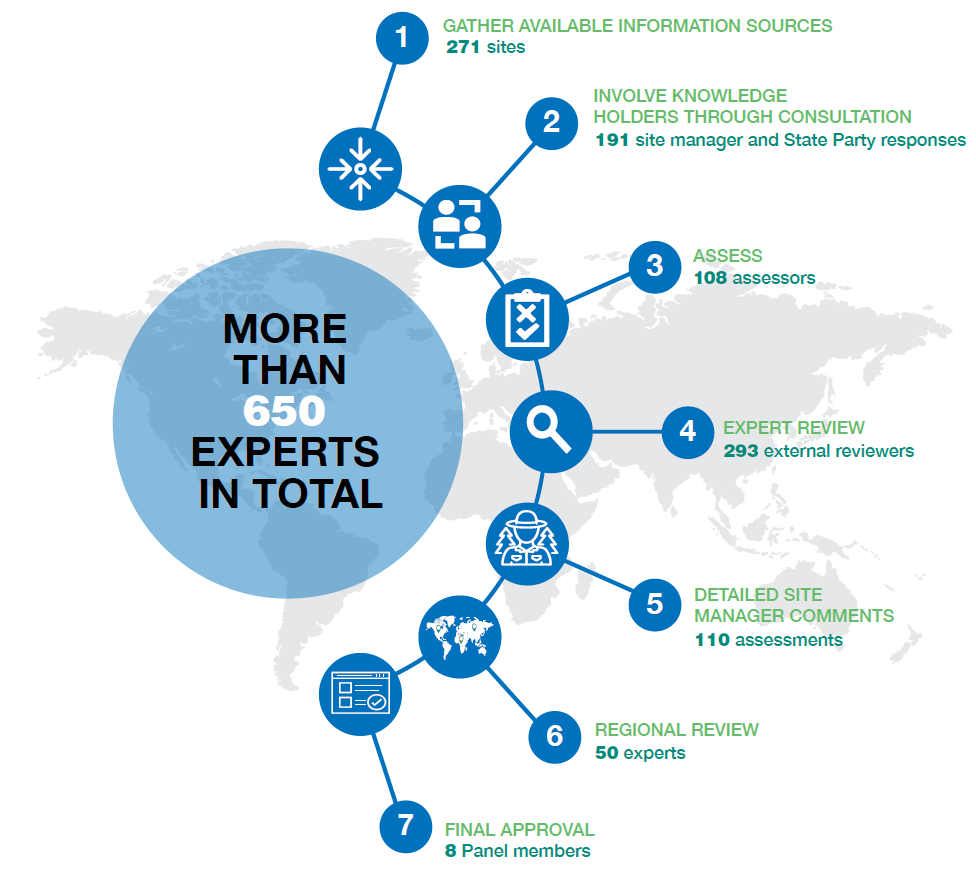
Each assessment undergoes several internal and external reviews before finalisation. Draft assessments, prepared by assessors (independent experts) selected for their knowledge of a site, are first reviewed internally to verify that they meet the required standards. Inputs are then sought from external peer reviewers. Following this, all assessments are reviewed by IUCN’s operational regions. These Regional Review Groups consist of the IUCN WCPA Regional Vice-Chairs and IUCN SSC Regional Vice-Chairs, representatives of the IUCN regional offices, and regional specialists for World Heritage. A final draft is then prepared for each Conservation Outlook Assessment, incorporating feedback from site managers and management authorities. The IUCN World Heritage Panel, composed of conservation experts specialised in fields relevant to the World Heritage process, provides final approval of all completed assessments.
Main steps in the IUCN World Heritage Outlook consultation process
Conservation Outlook Assessments are reviewed every three to five years.
If you have any feedback on a natural World Heritage site that you would like to share with the IUCN World Heritage Outlook, please contact us. You can submit your feedback by filling the online feedback form or via email at worldheritageoutlook [at] iucn [dot] org (worldheritageoutlook[at]iucn[dot]org)